
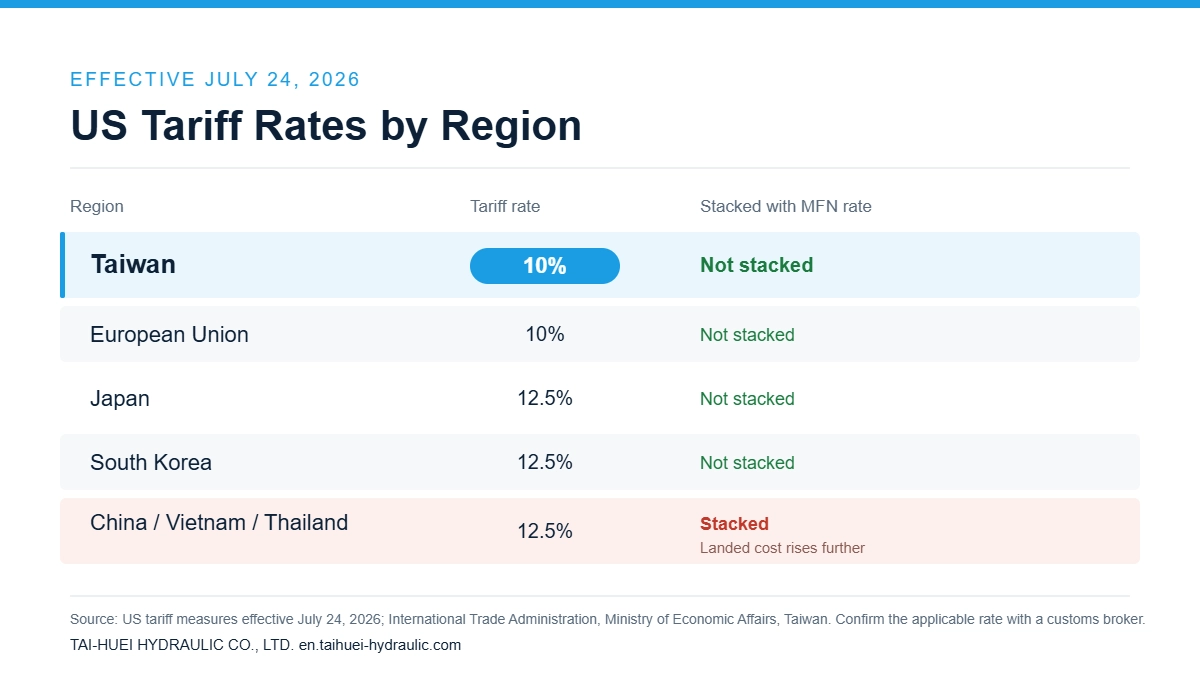
This round of tariff changes has left Taiwanese equipment builders in a more favorable position than manufacturers in other countries.
Since July 24, 2026, the United States has applied new tariff measures to a number of trading partners. Depending on the published rules and the conditions that apply, some Taiwanese products now have new competitive room compared with other major manufacturing regions.
For equipment manufacturers, that is not just a change to a line on a cost sheet.
As customers start re-evaluating where they source from, Taiwanese machine tools and automation equipment may gain more opportunities to enter the US market.
The problem is that redirected orders do not wait for you to build stock.
The hard part about redirected orders is not that they get bigger. It is that they get harder to predict.
Looking at what customers have been dealing with recently, this wave of orders has a few things in common.
They are urgent. Buyers decide to move an order at short notice, and lead times get tight. Before an equipment builder can even quote, they need to know whether the critical components can be scheduled into the production plan.
Volumes are not fixed. The buyers themselves are still waiting to see how things settle. They usually start with a small trial batch and only add to it once they are confident. This is the order pattern that puts the most strain on a supply chain: when volumes are low, a supplier may not be willing to commit to a production run; when volumes suddenly rise, they may not be able to supply in time.
Specifications often need adjusting. A machine may have been built around one particular brand of valve. When the supplier changes, the spool type, coil voltage, connector type and other specifications may all need to be re-checked or adjusted.
When all three land at once, what really gets tested is usually not price. It is whether the supplier can keep pace with changes to both orders and specifications.
When orders swing, three things about a supplier get magnified
In a stable market, the gap between component suppliers is not always obvious. Once rush orders, small batches and spec changes enter the picture, that gap starts to show.
Lead time
When a rush order comes in, lead time is often what decides whether an equipment builder can take it at all.
Tai-Huei’s lead time for standard products is approximately 3 to 5 working days, counted from the date a formal order is received. Actual lead time still depends on order quantity, product specification and production scheduling. Where quantities are larger or specifications need adjusting, lead time is confirmed separately.
Keeping lead times short is not only a matter of moving fast.
It comes down to how the core components are made, and to keeping a certain level of stock on hand.
Tai-Huei machines its spools, coils and valve bodies in house rather than relying entirely on bought-in components for assembly. The waiting time that some bought-in parts can introduce is therefore not a necessary step in the core process. The factory also keeps a certain level of stock of commonly used specifications to cover immediate customer requirements. Where the specification and stock position allow, an order confirmed today can reach the customer as early as the following day. For an equipment builder, that means more than a short lead time: it means being able to confirm availability quickly when a rush order lands, and lowering the risk that waiting on one component pushes out delivery of the whole machine. (Actual delivery still depends on product specification, order quantity, stock position and destination.)
For builders who need to confirm supply quickly, this translates into more direct control over production scheduling and delivery dates.
Consistent quality
When order volumes are low, one defective part can cost more than it would in a good year.
Once the machine has been delivered to the end user, a directional control valve that behaves abnormally can mean machine downtime, an on-site repair and additional labor cost, and it may even affect the customer’s confidence in placing the next order.
What matters is not only whether defects occur, but whether they can be traced when they do. No manufacturing plant can guarantee a zero defect rate. The difference lies in how quickly the cause and the scope can be established after something goes wrong.
Every Tai-Huei valve carries a Body Code on the valve body. That code allows us to look up manufacturing information for the product, including the production date and related component information.
In practice this means: when a customer reports a problem with a particular valve, we can use the Body Code to look up the product information and help determine whether it is an isolated case or something that may involve a specific batch. If it is an isolated case, it can be handled on that unit. If a specific batch is involved, we can look further into the production and supply information for the related products and help establish the likely scope.
That leaves information to trace and a basis on which to judge. Compared with a product whose manufacturing information cannot be identified, traceability helps narrow the range that has to be inspected and dealt with, and reduces unnecessary teardown and replacement, shipping and machine downtime.
Willingness to work with you
This one is the hardest to quantify, and it is often the difference an equipment builder feels most directly.
When a specification needs adjusting, there is a real difference between a supplier who answers “that specification is not in the catalog” and one who answers “let us first check with engineering and machining whether that is feasible.”
What Tai-Huei can currently accommodate:
- Custom spool configuration (spool function)
- Adjusted coil voltage and connector type
- Private labeling
- Specification review and adjustment to drawing
Three things to check before you change supplier
If you are evaluating replacing the valves on your equipment with Taiwanese-made products, these three are worth confirming first.
- Mounting interface
If both products use the ISO 4401 mounting interface, mounting holes and port positions will generally correspond, although whether the subplate needs remaking should still be confirmed against the actual specification.
Tai-Huei equivalents:
- G02 — D03 / NG6 / CETOP 3
- G03 — D05 / NG10 / CETOP 5
ISO 4401 governs the mounting interface. It does not mean products from different manufacturers perform identically. Performance parameters such as spool design, rated flow, maximum working pressure and the pressure-drop curve can differ with the product design and the manufacturer. A valve that bolts on will not necessarily behave the same way in operation. A full specification check before switching is recommended.
- Coil specification
Rated voltage and supply type have to match. Carrying over the existing power arrangement without confirming the new valve’s coil specification can lead to overheating, abnormal operation or coil failure.
Before switching, we recommend confirming:
- AC or DC supply
- Rated voltage
- Site supply conditions
- Actual operating environment
If you want to look further into why coils fail: Why Hydraulic Solenoid Valve Coils Overheat and Burn Out
- Connector type
Connector types Tai-Huei can supply:
- DL — DIN Plug Type
- LW — Terminal Box Type
- 2W — Two Wires Type
- DT — Deutsch Connector Type
- M4 — M12-4Pin Type Fast Connector (M12-4PIN)
Connector types can differ in installation space, protection requirements and how convenient they are to maintain on site. If the connector type is not confirmed at the same time as the valve is changed, the wiring may have to be reconfigured afterwards.
More on connectors and wiring: Hydraulic Solenoid Valve Connectors: Comparing 5 Wiring Types, IP Ratings and Selection Criteria
Send us the model number and we will check it against our range
If you are currently running another brand’s directional control valve and want to know whether there is a Tai-Huei equivalent, send us the following and our technical department will check it:
- Current model number and manufacturer (photo or text)
- Mounting interface specification
- Maximum system working pressure and required flow
- Coil voltage and connector type
- Operating environment (moisture, dust, high temperature)
Checking the specification first and confirming lead time second is usually more practical than comparing prices alone.
If you already use Tai-Huei valves, you can simply send the Body Code from the valve body and we will look up the product information for you. There is no need to dig out the catalog.
Contact Us | Technical Support
Written by the Tai-Huei Technical Department
Note on tariff information: the tariff information in this article is based on the measures effective from July 24, 2026 and on announcements from the International Trade Administration, Ministry of Economic Affairs, Taiwan. The rate that actually applies can vary with product tariff classification, origin determination and the circumstances of the import declaration. Before importing, we recommend confirming with a professional customs broker or the relevant authority.
Last updated: September 2026