
The solenoid coil is the component inside a hydraulic solenoid valve that converts an electrical signal into electromagnetic force. When selecting or replacing a coil, at least eight specifications should be confirmed: supply type (AC or DC), rated voltage, rated power, duty cycle, connector type, IP rating, coil dimensions and armature tube, and the compatible valve series. If any key specification does not match, the coil may fail to pull in completely, overheat during operation, or fail prematurely.
In the field, one of the most common approaches is to replace a coil with one that looks the same as the original. However, coils with a similar appearance can have completely different electrical ratings, dimensions, and magnetic circuit designs. Appearance alone is therefore not enough to determine whether a coil is compatible.
This article follows the same sequence used in practical coil selection: first, the differences between AC and DC coils; then, the applications and selection considerations for each TAI-HUEI coil type; and finally, how to choose between IP65, IP67, and IP68 protection ratings.
If a coil repeatedly burns out instead of simply reaching the end of its service life, read Why Hydraulic Solenoid Valve Coils Overheat and Burn Out first. Identifying the root cause of overheating or coil damage is essential before selecting a replacement coil. Once the cause has been addressed, return to this guide to confirm the correct coil specifications.
A 30-Second Overview: The 8 Things to Check
The table below follows the order in which these checks are typically made. The first items confirm that the coil has the correct electrical specifications and can actuate the valve properly. The later items confirm physical compatibility, installation requirements, and suitability for the operating environment.
No. | What to Check | What to Confirm | Typical Examples |
|---|---|---|---|
1 | Supply Type | Whether the valve is driven by AC or DC | AC |
2 | Rated Voltage | Whether the voltage marked on the coil matches the actual supply voltage | DC 12V |
3 | Rated Power | Whether the rated power is appropriate for the required magnetic force and heat generation | As specified in the catalogue and on the coil marking |
4 | Duty Cycle | Whether the application requires intermittent operation, continuous energization, or frequent switching | For continuous-duty applications, evaluate the Y/YV coil types listed in the catalogue |
5 | Connector Type | Whether the connector matches the site wiring and installation requirements | DL |
6 | IP Rating | Whether the protection level is suitable for the moisture, dust, and other environmental conditions at the installation site | IP65 |
7 | Coil Dimensions and | Bore size, coil height, fixing method, and armature tube specifications | Confirm against the original coil and the catalogue |
8 | Valve Series | Whether the coil is compatible with the valve body, armature tube, and corresponding valve series | G02/D03 |
AC and DC coils cannot be interchanged: the matching armature tube can differ in size and construction. For how AC and DC differ in heat generation and burnout, see Why Hydraulic Solenoid Valve Coils Overheat and Burn Out.
Why these 8 checks matter
A coil should not be selected based on voltage or appearance alone. Electrical specifications, physical dimensions, armature tube configuration, connector type, and valve-series compatibility all affect whether the coil will operate correctly after installation.
For replacement coils, the safest approach is to check the original coil marking against the catalogue specifications and confirm all eight items before ordering.
Do not select a coil on voltage alone
If the original coil is DC 24V, that does not mean any coil marked DC 24V can be installed as a direct replacement. In addition to rated voltage, you still need to confirm the rated power, connector type, coil dimensions, armature tube specifications, and compatible valve series.
This is particularly important when replacing a coil with one from a different brand or series. Even when the voltage and appearance appear identical, differences in the magnetic circuit, bore size, or armature tube specifications may prevent the coil from pulling in correctly or make installation impossible.
A hydraulic solenoid valve coil should therefore never be selected simply because it looks similar or has the same voltage rating. Always verify the coil against the original coil marking, the valve specifications, and the manufacturer's product catalogue.
Actual voltage ratings, power ratings, dimensions, IP ratings, and applicable valve series should be confirmed according to the TAI-HUEI catalogue and the specifications marked on the coil itself.
How does a solenoid coil work?
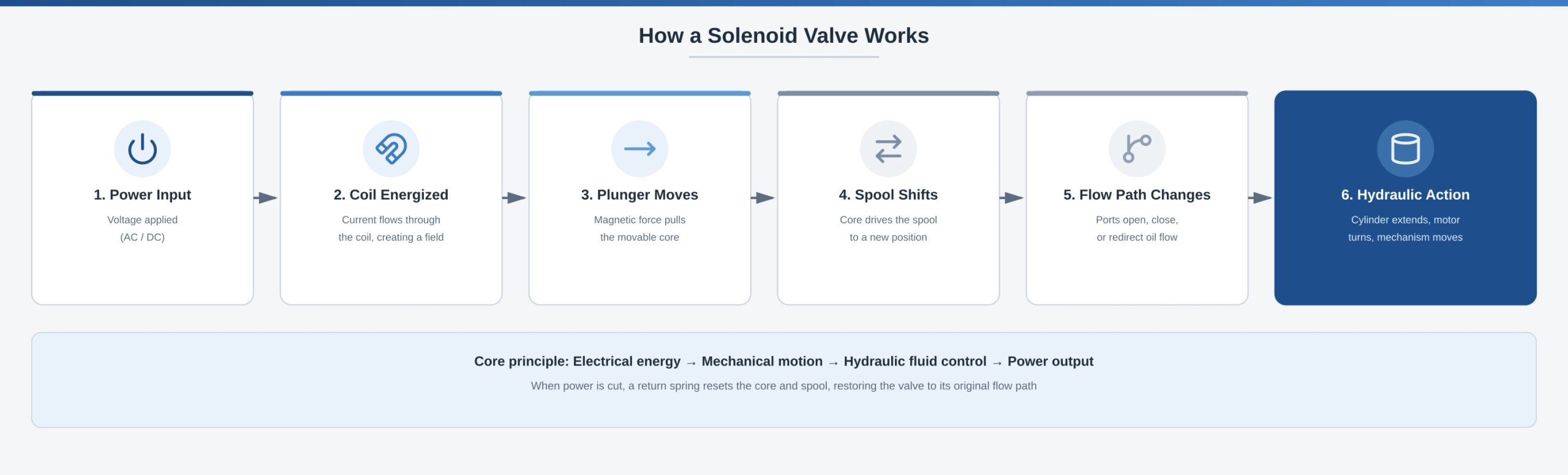
A hydraulic solenoid valve uses an electrical signal to shift the valve and change the direction of hydraulic oil flow. The solenoid coil is the component that converts electrical energy into electromagnetic force.
When the coil is energized, it generates a magnetic field that produces a force on the armature inside the armature tube. The armature then moves the valve's internal mechanism, shifting the spool to a different position. This changes the connections between the oil passages and controls the direction of hydraulic oil flow.
The operating sequence can be summarized as:
A solenoid coil generates a certain amount of heat while it is energized. This is normal for an electromagnetic component. The temperature rise depends on factors such as the rated power, energization time, ambient temperature, and cooling conditions.
What requires attention is abnormal overheating, a burnt smell, discoloration, degraded insulation, or repeated coil burnout. If a coil overheats or fails repeatedly, simply replacing the coil rarely solves the underlying problem. Check the supply voltage, coil specifications, duty conditions, and surrounding cooling conditions as well.
Which coil types does TAI-HUEI offer?
TAI-HUEI offers a range of solenoid coil types designed for different electrical requirements, operating conditions, and installation environments:
Coil Type | Main Characteristics | IP Rating | Typical Applications |
|---|---|---|---|
| Y/YV Low-Temperature-Rise, Energy-Saving Type | Reduced operating current and temperature rise; YV provides a lower temperature rise | Per specification | Continuous-duty applications, G02 DC solenoid valves |
| RFN Special Electrical Type | Uses a dedicated connector for the associated rectification or electrical control function | Per specification | Special AC/DC electrical applications |
| 2W Two-Wire Type | Leads exit directly from the coil, eliminating the need for an external connector | IP67 (per specification) | Damp, outdoor, or space-restricted equipment |
| DT Deutsch Connector Type | Deutsch locking quick connector with resistance to vibration and weather conditions | IP68 (per specification) | Construction machinery, vehicle-mounted equipment, and outdoor hydraulic systems |
| M4 Pin Connector Type | Standard M12 4-pin connector; both solenoids can be controlled through a single connector | Per specification | PLC and distributed I/O systems |
| DL Indicator / LW Terminal Box Standard Types | Standard configurations with an indicator light (DL) or terminal box (LW) | IP65 (per specification) | General industrial equipment and automation machinery |
The voltage, power rating, dimensions, and IP rating of each coil type should be confirmed according to the TAI-HUEI catalogue and the applicable product specifications.
For more detailed information on connector specifications, wiring methods, and IP ratings, see: Hydraulic Solenoid Valve Connectors: Comparing 5 Wiring Types, IP Ratings and Selection Criteria.
Y/YV low temperature rise, energy-saving coils
Hydraulic equipment that remains energized for long periods places a continuous thermal load on the solenoid coil. When several solenoid valves are installed in the same control system or a machine operates continuously, coil temperature rise becomes an important design consideration.
TAI-HUEI G02 Y/YV Low-Temperature-Rise, Energy-Saving Solenoid Directional Valve
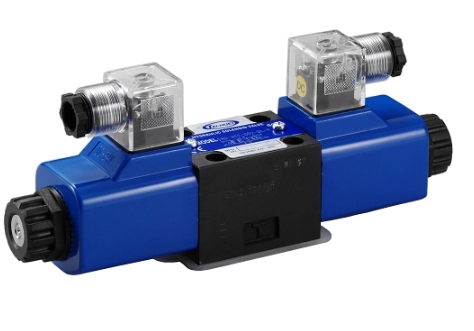
The TAI-HUEI Y/YV series is designed for G02 DC solenoid valves. The solenoid, armature tube, and coil are designed as a matched system to reduce operating current and temperature rise.
Within the series, the YV type provides a lower temperature rise than the Y type. It is therefore suitable for equipment that remains energized for extended periods or requires reduced temperature rise and lower current consumption.
According to catalogue test results, under the same test conditions, the YV coil has a lower temperature rise than the Y coil. In applications where the coil remains continuously energized, this can help reduce the thermal load on the coil and surrounding components.
- Lower temperature rise: The YV type shows a lower temperature rise under the specified test conditions.
- Lower current consumption: The coil design reduces operating current, helping to reduce energy consumption during operation.
- Suitable for continuous duty: The lower temperature rise makes the Y/YV series suitable for hydraulic equipment that remains energized for extended periods.
- Designed for the G02 DC series: The Y/YV series is designed for use with G02 DC solenoid valves according to the applicable specifications.
- Low-voltage pull-in: The Y/YV series can pull in at a supply voltage as low as DC 20V, according to the applicable specifications.
The Y/YV series is not simply a matter of reducing coil wattage. The reduction in temperature rise and operating current results from the coordinated design of the solenoid, armature tube, and coil as a complete system.
RFN AC/DC conversion coils
RFN is a special electrical coil type. By design, an RFN coil must be used with its dedicated connector. The coil and connector work together to provide the specified rectification or electrical control function.
When selecting or replacing an RFN coil, appearance and rated voltage alone are not sufficient. The following specifications must be confirmed together:
RFN coil + dedicated connector + electrical rating + armature tube / valve body specification
Using an incompatible connector may result in incomplete pull-in, incomplete valve shifting, failure of the rectification or control function, or abnormal coil heating.
Before replacing an RFN coil, confirm the following:
- RFN type and supply: Confirm the AC/DC supply type and the corresponding electrical rating.
- Rated voltage: Confirm that the voltage marked on the coil matches the actual supply conditions.
- Dedicated connector: Confirm that the specified RFN connector is used.
- Armature tube type: Confirm that the coil and armature tube specifications are compatible.
- Rectification / control method: Confirm the electrical control function provided by the coil and its dedicated connector.
- Valve series and coil dimensions: Confirm that the coil is compatible with the original valve body and applicable valve series.
If a special armature tube, soft-shift design, or other special specification is involved, the coil should not be treated as a direct replacement for a standard coil. Always check the applicable product specifications before assuming that two coils are interchangeable.
Only have the old coil? What to send so we can identify it
A common situation on site is a valve whose nameplate has worn away, leaving only the coil that was removed. Measuring the outside diameter and height rarely helps; gather the following instead.
Five photographs:
- The complete valve — so single or double solenoid is visible
- The coil marking, straight on — voltage, model and electrical code
- The coil from the side — height and fixing method
- Where the coil meets the armature tube
- The connector or lead-out
If the valve still carries a nameplate, photograph that as well; it usually identifies the product faster than the coil itself.
Three pieces of written information: the valve model (for example HD-***-G02-…), the voltage and AC/DC marked on the coil, and the operating conditions (continuously energized, damp, outdoors).
The difference it makes: asking only "do you have a DC 24V coil?" leaves the supplier guessing. Sending "this is the valve currently installed, please confirm the replacement coil" with the photographs allows the specification to be matched to the actual product.
A six-step order for confirming a replacement
Step | What to confirm | Notes |
|---|---|---|
1 | Valve model | Find the G02, G03, G04, G06 or the full product code first |
2 | Coil marking | Voltage, AC/DC and type code |
3 | Special type | Y/YV, RFN or soft shift (S) |
4 | Armature tube | The armature tube the original coil works with |
5 | Wiring | The original connector or lead-out type |
6 | Size and fit | Cross-check dimensions last, not first |
The point of the order is to establish what the product is before measuring the part, rather than starting from appearance.
Two limits to watch: the armature tube of the soft shift (S) type cannot be interchanged with the standard type, and an RFN coil must be used with its RF dedicated connector — without it there is no rectification, and poor pull-in or coil burnout can follow.
Stocking spares: do not file them under "DC 24V" alone
If the store is organized only by DC 12V, DC 24V, AC 110V and AC 220V, it is easy to pick a coil at the right voltage with the wrong configuration.
Give each part number four parts: valve series + coil type + voltage + special code. "G02 + DC + 24V + S (soft shift)" is easier to find, and harder to pick wrongly, than "DC 24V".
Conclusion: match the specification before you change the coil
A solenoid valve coil should never be selected based on size and voltage alone. Follow the complete selection sequence: AC/DC → voltage → power → duty cycle → connector → IP rating → dimensions and armature tube → valve series.
TAI-HUEI offers Y/YV low-temperature-rise, RFN, 2W two-wire, and DT Deutsch connector coil options for different applications and operating requirements. If you are unsure which coil is suitable for your equipment, provide the marking on the original coil, the valve type, and the operating environment. The TAI-HUEI technical team can help confirm the applicable coil specifications.